tshirt printing business plan kenya: A Practical Planning Template
Turn your T-shirt printing idea into a working business plan with clear customer priorities, production choices, cash-flow assumptions and review checkpoints.
Searching for “tshirt printing business plan kenya” is useful when you need more than a machine shopping list. A working plan should explain who will buy, how orders will move through production, when cash will arrive and what evidence will justify expansion. For a Kenyan print shop, these decisions belong in the same document.
Rather than treating the plan as a document you finish once, use it to test assumptions against enquiries, completed jobs and actual expenses.
Your tshirt printing business plan kenya template
Build your plan around the sections below. Keep each section specific enough that another person could understand your offer and follow your order process. Where information is missing, label it as an assumption instead of presenting it as a confirmed figure.
Define the customer and the offer
Choose a customer group to investigate first, such as businesses ordering staff T-shirts, teams or event organisers. These are possible segments to test, not proof of demand.
Write down:
- Who approves the artwork and authorises payment.
- Which garment styles, sizes and print positions customers request.
- Whether orders are individual purchases, group orders or repeat work.
- How customers will enquire, approve designs and receive their garments.
Describe the offer in plain language. For example, you might plan to quote for printed T-shirts with garment sourcing, artwork preparation and delivery shown separately. Confirm what you can actually provide before advertising it.
Record evidence before forecasting sales
Keep an enquiry log showing requested quantities, garment preferences, deadlines and reasons quotations were accepted or declined. Separate genuine enquiries from paid orders.
Your sales forecast should explain its assumptions. Avoid filling a spreadsheet with expected orders simply because a machine appears capable of producing them. Production capacity and customer demand are different questions.
Set out your production model
State which stages you intend to handle yourself and which you may outsource. Cover artwork preparation, transfer production, pressing, inspection and packing. If using an outside producer, confirm their requirements and turnaround before building them into your customer commitments.
Link equipment to a defined task
The Yinghe 38 × 38cm Flatbed Heat Press Machine, listed at KES 29,999, is designed for garment printing, including DTF transfers and heat-transfer vinyl. In your plan, explain how pressing fits into the order workflow rather than treating the press as the whole business.
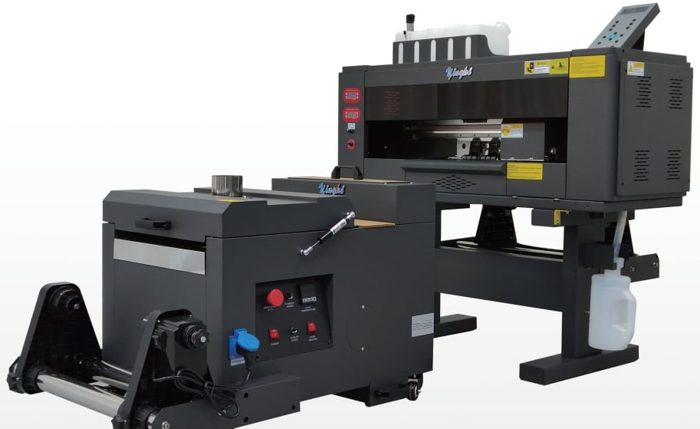
If you are evaluating in-house transfer production, the YH-A3 DTF printer + powder shaking machine is listed at KES 470,250 with Epson XP600 x2. Confirm the supplied configuration and operating requirements before making a purchase decision.
Include PET film & hot melt powder in the materials discussion for a DTF workflow. Specifications and prices are confirmed on WhatsApp. Check compatibility with the selected equipment and transfer process before ordering.
These catalogue prices are individual product references, not a complete business setup quotation.
Build a cash-flow plan, not just a profit forecast
Separate money needed to establish the operation from money needed to keep orders moving.
- Record equipment purchases and any quoted setup services separately.
- Allow for garments, transfers or printing consumables, packaging and delivery.
- Include premises, utilities, staffing and maintenance where applicable.
- Record when customer payments are expected and when suppliers must be paid.
- Allow for samples, rejected prints and rework using your own records as they develop.
Prepare a quieter-sales scenario alongside your main forecast. Ask whether you could meet commitments if customers ordered less than expected or paid later than planned. Do not assume that a profitable quotation automatically leaves enough cash available for the next job.
Document order controls and responsibilities
A business plan should show how you will protect consistency as work increases.
Use a job sheet to record garment quantities, sizes, approved artwork, print placement and the agreed completion date. Identify who checks incoming garments, approves a test application and inspects finished work.
Follow the relevant material and equipment instructions for application settings. Test unfamiliar garment and transfer combinations before committing a customer’s full order.
SEAFAR’s Machine Operation & Technical Training covers running, caring for and troubleshooting equipment. Identify training needs in the plan rather than assuming every operator already has the required skills.
Define when to review or expand
Set review checkpoints using completed-job records. Compare enquiries, accepted quotations, cash collected, rework and production delays with your assumptions.
Before adding equipment, identify the actual constraint: insufficient enquiries, slow artwork approval, transfer availability or pressing workload. Printing Business Setup & Production Planning can help plan a new or expanding operation around what customers buy.
Next steps
Share your customer focus, proposed workflow and equipment shortlist with SEAFAR International. WhatsApp +254 795 463 928 or email ENQUIRIES@SINTL.CO.KE to confirm quotations and discuss planning support.