sintl.co.ke: Choose the Right Film for Your Printing Job
PET film, printable PU and cutting films serve different workflows. Use this shopping guide to identify your process and check compatibility before ordering.
Searching sintl.co.ke for printing film is a useful starting point, but the word “film” covers materials with different jobs. A garment transfer, a cut lettering design and a printed graphic do not necessarily use the same material. For Kenyan print shops and branding businesses, the practical shopping question is not simply “Which film is cheapest?” It is “Which material matches this production process and finished item?”
Start with the job, not the material name
Before browsing, write down what you want to produce and how you intend to produce it. This helps separate a material requirement from a machine requirement.
Your brief should include:
- The finished item, such as a T-shirt, uniform or sign.
- The surface or fabric receiving the design.
- Whether the artwork will be printed, cut or both.
- The printer, cutter and transfer equipment you already use.
- The finish the customer expects.
Terms such as “transfer film”, “vinyl” and “PET film” are not interchangeable. A photograph of a finished design may help explain your goal, but it should accompany equipment and material details rather than replace them.
Reading film listings on sintl.co.ke
SEAFAR International’s catalogue includes several relevant consumable groups. Treat these as starting points for identifying the correct material, rather than assuming every item within a group works with every printer.
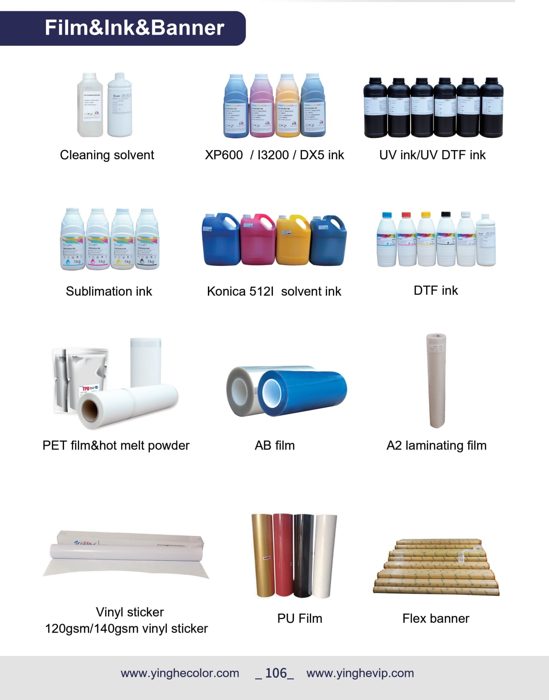
PET film and hot-melt powder
The PET film and hot-melt powder listing is relevant when discussing a DTF garment-transfer workflow. In this process, the printed transfer, adhesive powder and application stage need to work together.
Before ordering, ask for the film specifications and the recommended handling, curing and peeling instructions for the proposed material. Confirm compatibility with your existing DTF ink and equipment. Do not assume that settings used for a previous film will suit a different one.
Prices are confirmed on WhatsApp.
Film, ink and banner consumables
The film, ink and banner listing includes DTF ink, PET film and hot-melt powder, alongside other consumables such as UV ink, UV DTF ink and sublimation ink.
This range is useful when checking the materials required for a process. However, being listed together does not make the inks interchangeable. State the printing process explicitly when enquiring. “DTF ink” and “UV DTF ink” should not be treated as two names for the same purchase.
Prices are confirmed on WhatsApp, and specifications should be checked for the intended application.
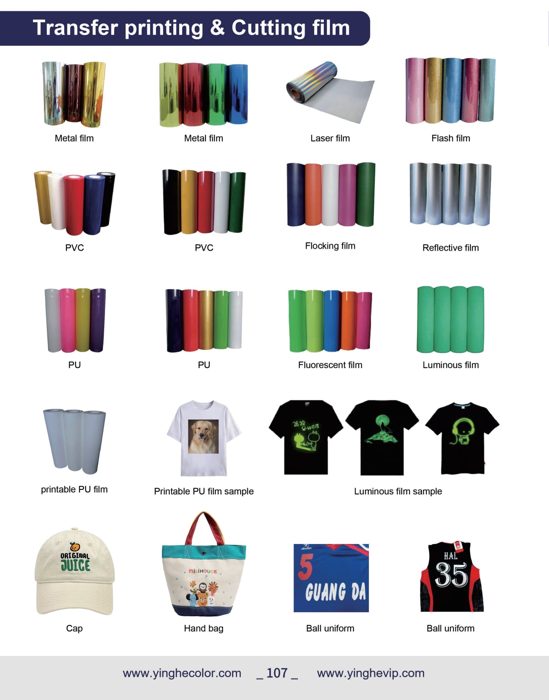
Transfer printing and cutting film
The transfer printing and cutting film range lists materials including flocking, reflective, PU, fluorescent, luminous and printable PU film.
For cut designs, check whether the proposed material is intended for cutting and weeding. For printable PU, confirm the supported printing process and any subsequent cutting or transfer requirements. A request for “PU film” alone leaves an important distinction unresolved: do you need a cut-only material or a printable one?
Prices are confirmed on WhatsApp.
Check the application equipment as well
A suitable film still needs an appropriate application method. For heat-applied garment work, identify the press and explain the size and placement of your designs.
The Yinghe 38 × 38cm Flatbed Heat Press Machine is listed at KES 29,999 and is described for garment printing, DTF transfers and heat-transfer vinyl. That does not establish a universal setting for every transfer material.
Follow the confirmed material instructions for temperature, pressure, pressing and peeling. Check the garment’s suitability for the process too. The press, transfer and receiving fabric must be considered together.
Test the proposed material before committing to production
Where possible, arrange a small trial using the intended artwork and receiving material before committing to a larger purchase or customer run. Ask whether a sample or trial quantity can be supplied; do not assume this is included.
During the trial:
- Check how the material feeds, cuts or releases, as applicable.
- Inspect edges, fine details and the overall finish.
- Assess adhesion after the transfer has been applied correctly.
- For garments, assess suitability through appropriate wash testing.
- Record the material reference and settings used.
If the result is inconsistent, avoid changing several settings at once. SEAFAR’s production workflow and technical consulting offers advice on achieving more consistent output from existing equipment and materials.
Next steps
Browse parts and consumables on sintl.co.ke, then WhatsApp +254 795 463 928 or email ENQUIRIES@SINTL.CO.KE. Share your process, machine model, receiving material and preferred finish to confirm specifications and prices before ordering.